
A conveyancing file rarely turns on a judgment. It turns on whether the right instrument was applied, in the form it had when the application went in. Land Registry rules and practice directions are where that question gets settled, and for years it has been settled with a folder of saved PDFs and the hope that nothing moved.
Land Registry material is not a single collection, and the three kinds of document in it do not do the same job.
Three kinds of document, three different jobs
Land Registry Rules govern registration itself: what has to be lodged, in what form, and what the Registry does with it once it arrives. They are the largest of the three groups by a wide margin.
Land Registry Practice Directions set out how the Registry will handle a category of application. They do not change the underlying requirement. They tell a practitioner what to expect when meeting it.
Legal Office Notices carry the operational position on a specific point, and they are the ones most likely to move at short notice. Fees, forms, and the treatment of a particular kind of lodgement tend to surface here first.
For a property solicitor, mixing the three is not an academic error. Advising a client on the basis of a practice direction when a rule governs, or working from a notice that has since been superseded, produces a different answer and a different timeline for the transaction.
The documents are all published. The link between them is not recorded anywhere
Any one of these can be found on its own. What takes time is the relationship between them, and between them and the legislation behind them.
A rule is made under an Act. A later statutory instrument amends it. A practice direction is issued on the strength of that amendment, and a legal office notice adjusts how it operates day to day. Read in isolation, each document looks complete. Read together, they answer the question that matters on a file: which version was in force when your client signed.
Reconstructing that by hand means holding several sources open at once and checking each one for amendment. On a busy conveyancing desk, that check is the first thing to go.
Where Land Registry rules and practice directions sit on Vizlegal
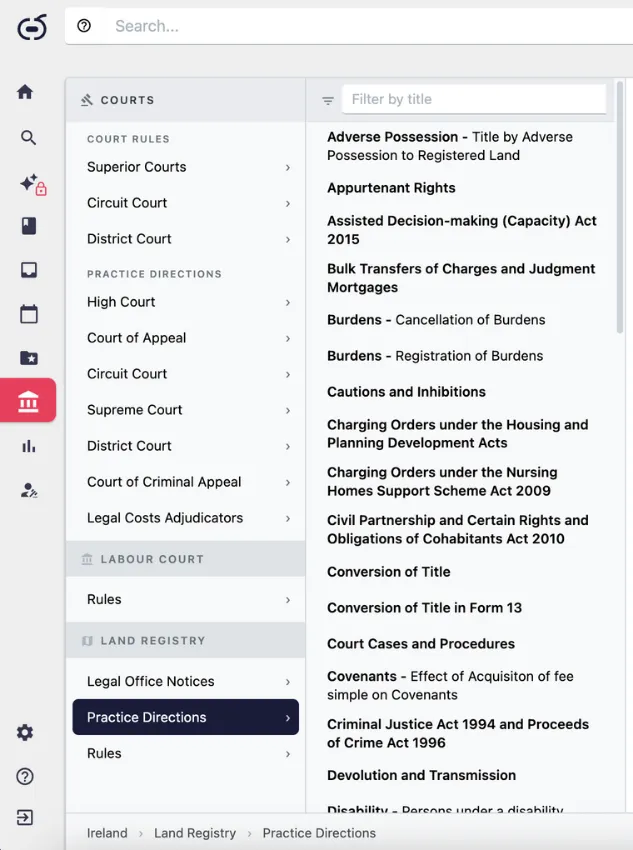
They sit in the court rules area, as three entries of their own. Legal Office Notices, Practice Directions, and Rules each open separately, so a practitioner goes to the document type the question belongs to instead of working across a mixed collection. Within a selected collection, a title filter narrows the list further.
The registry material is arranged next to the court material rather than apart from it. Court Rules holds the Superior Courts, Circuit Court, and District Court rules. Practice Directions holds those of the High Court, the Court of Appeal, the Supreme Court, the Circuit Court, the District Court, the Court of Criminal Appeal, and the Legal Costs Adjudicators. The Labour Court rules sit alongside them.
That arrangement matters more than it first appears. A title question does not always stay a title question. When a boundary dispute, a priority argument, or a rectification application ends up in the Superior Courts, the practitioner needs the registry instrument and the court rule from the same session, not from two different systems and two different habits.
Our email service covers new and changed rules and practice directions, so a change to the Land Registry material reaches the desk instead of waiting to be found on the next search.
What this changes on a file
The gain is not speed for its own sake. It is that the version question gets answered in the same sitting as the substantive one, rather than deferred to a check nobody has time for. A conveyancer working from the full record is advising on it, not on a copy of it. Explore it now: https://app.vizlegal.com/
To see how the Land Registry material is organised, get in touch at vizlegal.com/contact.