
Verified legal information: why every result should trace back to the primary source
Why legal research should trace back to the primary source, and how Vizlegal links every judgment, adjudication, and decision to its originating document.
A legal position is only as reliable as the source it rests on. When advice, a submission, or a report about a case is questioned, the query is always the same: where does this come from, and can it be shown. For practitioners working across Irish and UK sources, the harder part is often not finding an answer but standing over it, tracing a summary, a headline, or a secondary account back to the judgment, adjudication, or decision that actually says so.
That chain matters more than it used to. Verified legal information now competes for attention with generated text, aggregated summaries, and second-hand reporting that can drift a long way from the record. The value of a research tool is no longer only in what it surfaces. It is in whether every result points back to the document it came from.
When the source is hard to reach
In day-to-day practice, the primary source is often several steps away. A decision is referenced in a newsletter, which quotes a summary, which paraphrases the judgment. Each step is a place where nuance can be lost, and each one is a place a practitioner has to check before relying on the point.
The problem grows with the number of sources involved. Superior Court judgments, WRC and Labour Court adjudications, An Coimisiún Pleanála decisions, Tax Appeals determinations, Data Protection Commission decisions, Land Registry notices, and consolidated court rules each sit in their own place, in their own format. Assembling a reliable picture across all of them, and confirming that a summary reflects the underlying text, is slow manual work.
Primary sources, structured and linked
Vizlegal has been structuring Irish legal and regulatory data since 2019, drawing on more than fifteen official Irish sources and over five million documents. The point of that work is not volume for its own sake. It is that every result connects to the originating document.
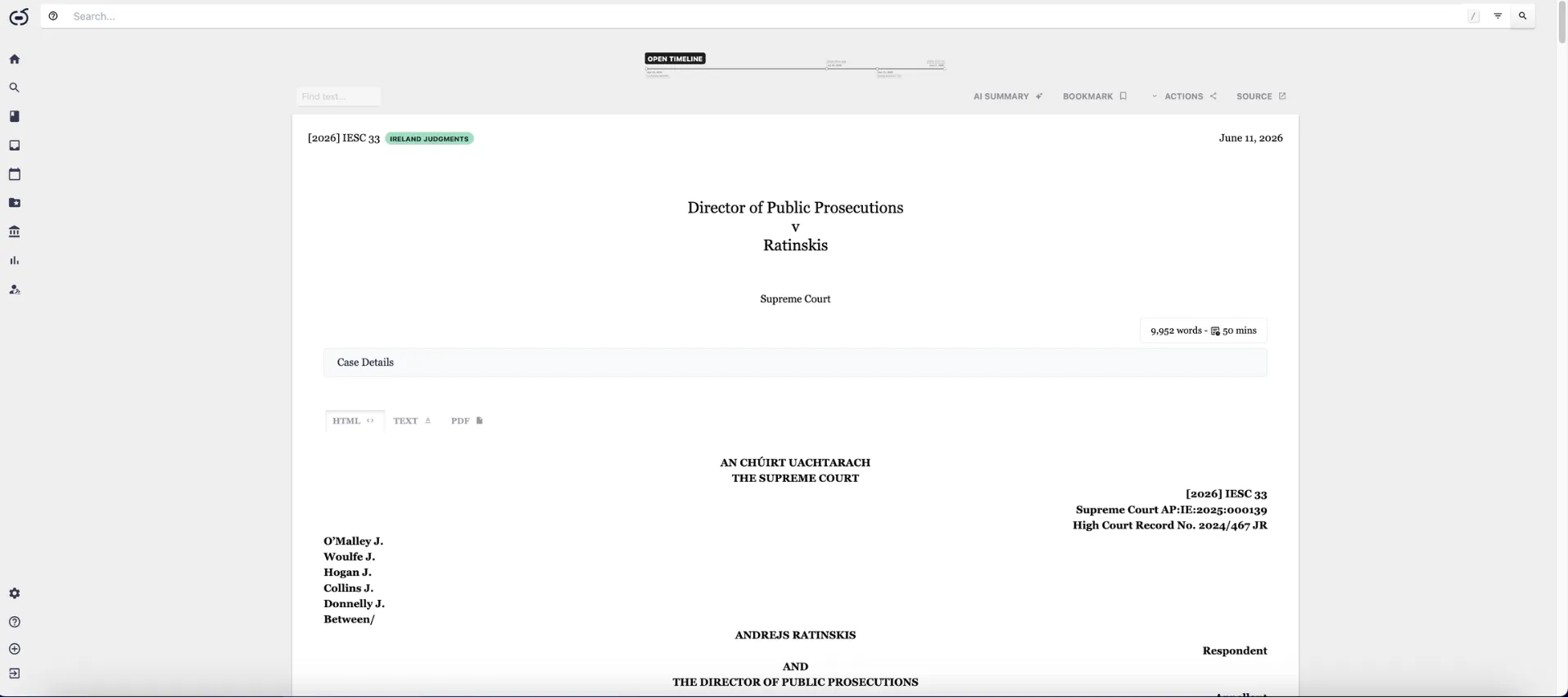
A search that returns a High Court judgment, a WRC adjudication, an An Coimisiún Pleanála decision, or a Tax Appeals determination links straight to the source text, one step away. It is the document itself, not a press release and not a secondary report. For a practitioner, that means a finding can be checked, cited, and stood over without leaving the platform to hunt for the original.
That provenance also holds across jurisdictions. Irish, UK, and European sources, including CJEU and ECHR case law, sit in the same structured environment, so a cross-border point can be traced to its source in the same way as a domestic one.
AI summaries that point back to the judgment
Speed and reliability are usually treated as a trade-off. Vizlegal's AI summaries are built to avoid that. They are developed with practitioners, presented as bullet points alongside a narrative summary, and tested with no hallucinations reported.
Their role is to signpost, not to replace. A summary shortens the time it takes to understand what a judgment decided and why, and then points the practitioner to the reasoning in the source. The judgment remains the authority. The summary is the fastest route to it, which is the opposite of a generated answer that a practitioner then has to verify from scratch.
Provenance across the life of a matter
Traceability applies to a single document, and it also applies to the history of a matter. Case Timelines set out the full procedural history of a case through its appeals chain, from the originating record through An Coimisiún Pleanála, judicial review, the Court of Appeal, the Supreme Court, and CJEU references where relevant.
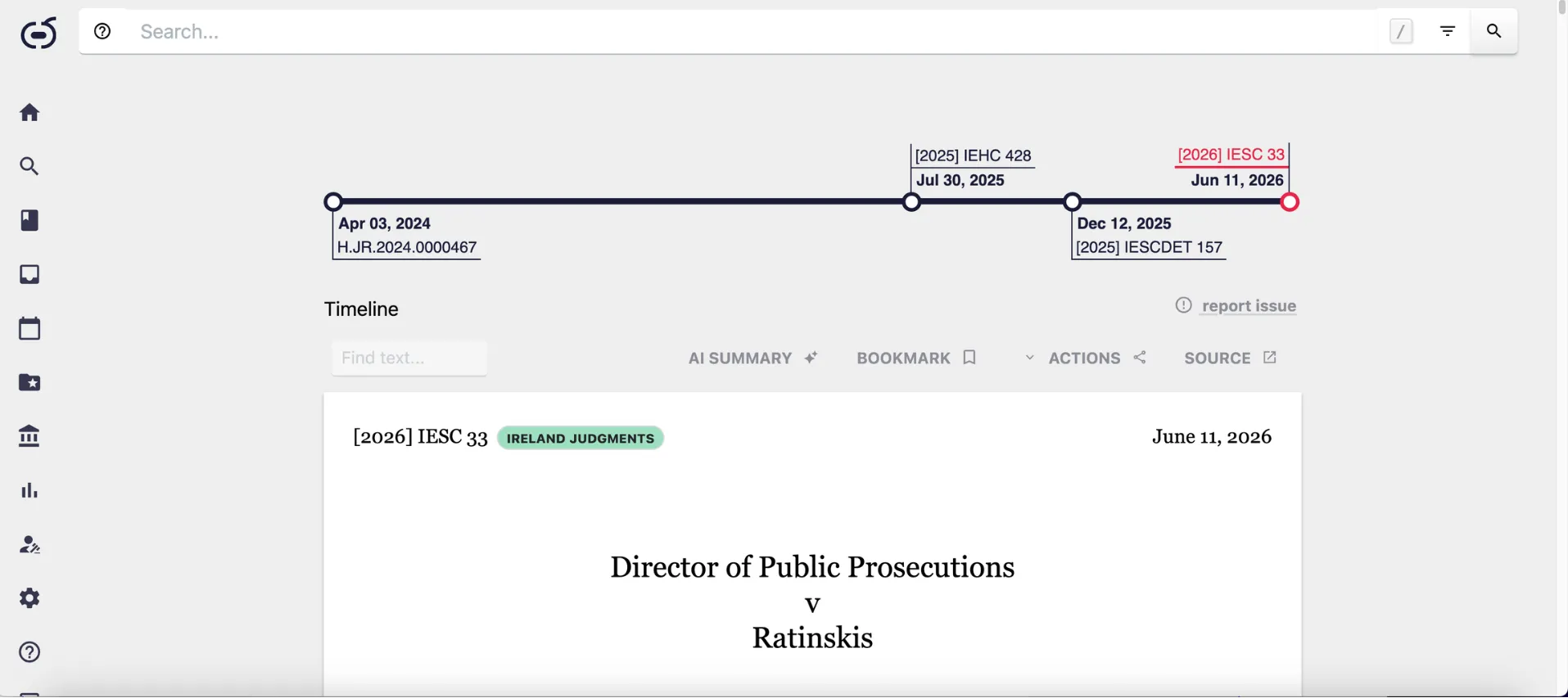
For a practitioner picking up a matter, that visual history answers a practical question quickly: how did this case get here, and what happened at each stage. Each step in the timeline connects back to its own source document, so the context of a decision is as traceable as the decision itself.
The practical takeaway
Verified legal information is not a slogan. In practice it comes down to a simple test: can every result be traced, in one step, to the primary source that supports it. That test is what lets a practitioner move quickly and still stand over the work.
Vizlegal is built around that test, structuring primary Irish, UK, and European sources so that judgments, adjudications, decisions, and rules stay one click from the result, with AI summaries that point back to the record rather than away from it.
To see how traceable research works across your practice area, book a demo at vizlegal.com/contact.